SHANGHAI — Data from the General Administration of Customs shows that in the first four months of 2026, the export value of China's electric vehicles (EVs) surged by 68.1% year-on-year. Since the beginning of 2026, leveraging their first-mover advantage in the new energy sector and robust capabilities in intelligent innovation, Chinese automotive brands have not only achieved a massive leap in export scale but have also become a driving force in global automotive R&D and design through deep integration with artificial intelligence (AI).
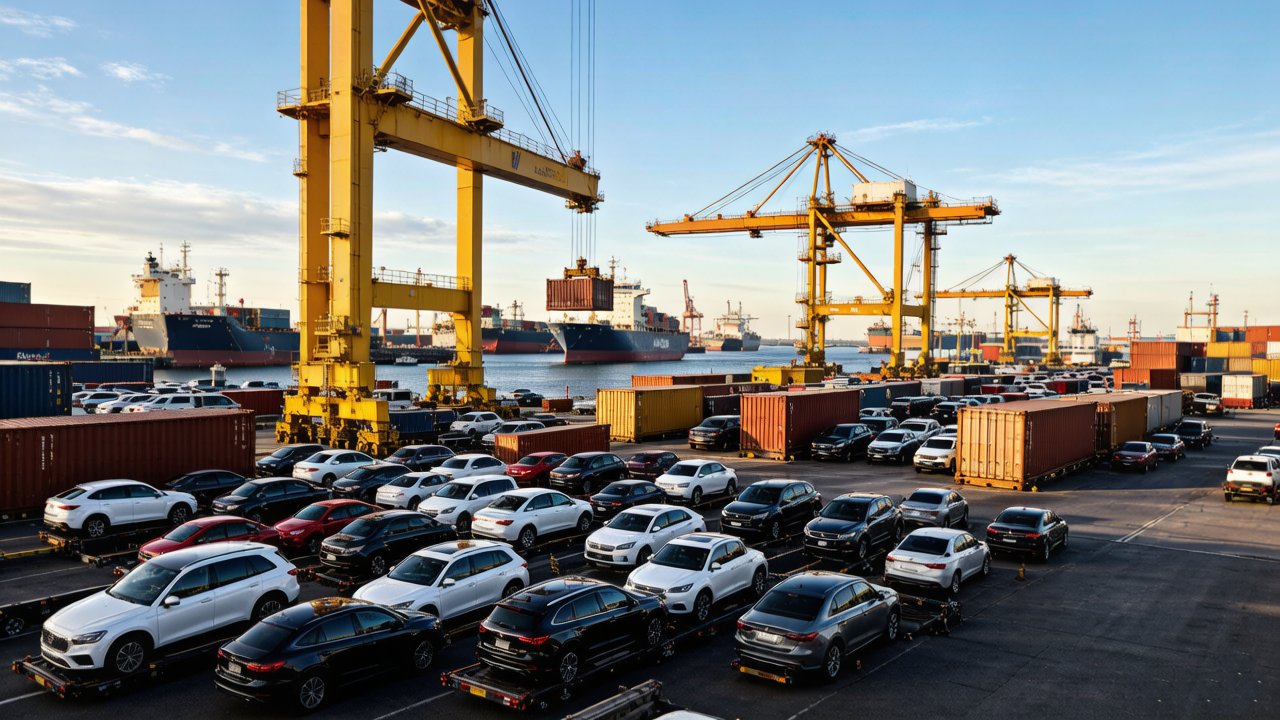
This momentum is highly visible at China's largest roll-on/roll-off (Ro-Ro) auto terminal in Shanghai. In 2025, more than 1.45 million vehicles were exported from this port, averaging nearly 4,000 vehicles a day. Broken down, this means less than every 30 seconds, a Chinese-made vehicle rolls out from this terminal toward the global market.
"The vessel closest to us has a total capacity of over 3,700 vehicles, the vast majority of which are new energy vehicles (NEVs) bound for Australia," said Li Gengjun, duty manager at Shanghai Haitong International Automotive Terminal Co., Ltd. "Our overall handling volume today is over 5,700 vehicles, which represents a standard daily workload. During peak periods, our maximum throughput can hit over 12,000 vehicles within a single 24-hour period."
According to Shanghai Customs statistics, in the first four months of 2026, electric vehicle exports through Shanghai ports reached 109.13 billion yuan, representing a 62.5% year-on-year growth.
Chen Jia, chief of the 9th Inspection Division of Waigaoqiao Port Customs under Shanghai Customs, noted: "In 2025, NEV exports accounted for about 40% of our total export volume. From January to April 2026, Waigaoqiao Port Customs supervised the export of 480,000 vehicles. Among them, the share of NEVs reached 66.6%, marking a significant increase."
Behind this dual growth in both export volume and value is the continuously unleashing innovative momentum of China's NEV industry. At the SAIC Motor Design Center in Shanghai, the world's first AI-native concept car made its debut, showcasing the latest breakthroughs in China's intelligent automotive design.
"AI should not be an add-on feature fitted as an afterthought; instead, it should be deeply integrated into the overall vehicle experience from the very start of R&D," explained Jozef Kabaň, Vice President of Global Design at the Design Center of SAIC Motor Innovation Research & Development Institute. "This car does not just understand users; it deeply perceives their habits, recognizes their personality and current emotions, and proactively adapts to deliver a more enjoyable driving and riding experience."
Kabaň officially joined the Chinese automaker in 2024, having previously served as the design chief for multiple iconic global automotive brands. In his view, a profound transformation is reshaping the global automotive design landscape, and the center of gravity is rapidly shifting toward China.
"The global automotive industry is undergoing a massive transformation, and China has become the epicenter of this change," Kabaň stated. He emphasized that his decision to join SAIC Motor was driven precisely by its scale, capability, technological advantages, and its determination and global mindset. For him, being part of the globalization process of Chinese enterprises holds immense significance.
In Kabaň’s eyes, Chinese companies and consumers show an exceptionally high acceptance of new technologies, and product iterations are remarkably fast, providing exceptionally fertile ground for NEV innovation. The new concept car he designed integrates AI deep into the vehicle's underlying architecture, co-developed with Chinese AI large-model enterprises to make the vehicle far more intuitive to human needs.